1 April 2026
With a sense of nostalgia and pride Drakenstein Municipality ushered in a new era for community rugby with the official reopening of the historic Die Kraal Sports Grounds in Paarl on Tuesday, 31 March 2026.

At the historic reopening of Die Kraal, Executive Mayor Councillor Stephen Korabie led a proud procession through a guard of honour, a symbolic tribute to the legacy and future of community rugby.
The event marked the first major milestone in a multi‑phase restoration project to revive one of the area's most treasured community sporting precincts.
Rugby, netball and cricket legends, together with respected community figures, gathered to honour Die Kraal's history and reflect on its role as a cradle of local sporting excellence.
For many, the reopening felt like a long‑awaited homecoming – a symbolic return to the fields where memories were forged, rivalries ignited and community spirit thrived.

The reopening of Die Kraal was a momentous occasion, as rugby legends gathered to honour its legacy and share in a historic day.
Francois Davids, Deputy President of the South African Rugby Union (SARU) and a respected figure in South African rugby, delivered the keynote address, highlighting the importance of Die Kraal as a unifying symbol in the community. Davids, who hails from Wellington, regaled his fellow Die Kraal legends with tongue-in-cheek stories about playing schoolboy rugby at Die Kraal against archrivals from neighbouring Paarl.
"This is not just an infrastructure project, but an investment in people, youth development and the future of South African rugby," he said. "To Drakenstein Municipality, you are not only building a sports facility, but also hope, opportunity and a legacy for the next generation. We look forward to the field being filled with the sounds of children playing and the cheers of supporters."
Davids expressed his gratitude and thanks to Drakenstein Municipality.
"You are the best municipality in the Western Cape and in the country. What you do takes a lot of work, so you can brag. It is not about politics; it is about service delivery."
Where it all began
Established on land once used for grazing cattle, Die Kraal was made available to the Coloured community in 1923 for sporting and cultural activities.
Rugby legends recall games played on Die Kraal's four fields with passion, the camaraderie of teammates and the unity created on and around the field — even during the hardships of Apartheid, when spectators were separated by law yet connected through sport.
It was once referred to as De Kraal, but after consultation with the community and legends, the sports grounds are now proudly called Die Kraal.
Once alive with the excitement of Saturday rugby, Die Kraal served as a gathering point where spectators, athletes and families shared the energy of local sport. The grounds hold a cherished place in the collective memory of the Paarl and Wellington community as a bustling hub hosting rugby, netball, hockey, cricket, athletics, choir performances, minstrel events and community events over many decades. Although the facility fell dormant in the 1980s, its legacy endured.
Today, Die Kraal is returning to its former glory. The Municipality's renewed investment signals the beginning of a transformative chapter for the precinct.
The official reopening of Die Kraal Sports Grounds was witnessed by the very generation of rugby players who built its legacy. The restoration of the historic sports grounds for R19.5 million has seen the revival of a beloved sporting landmark.
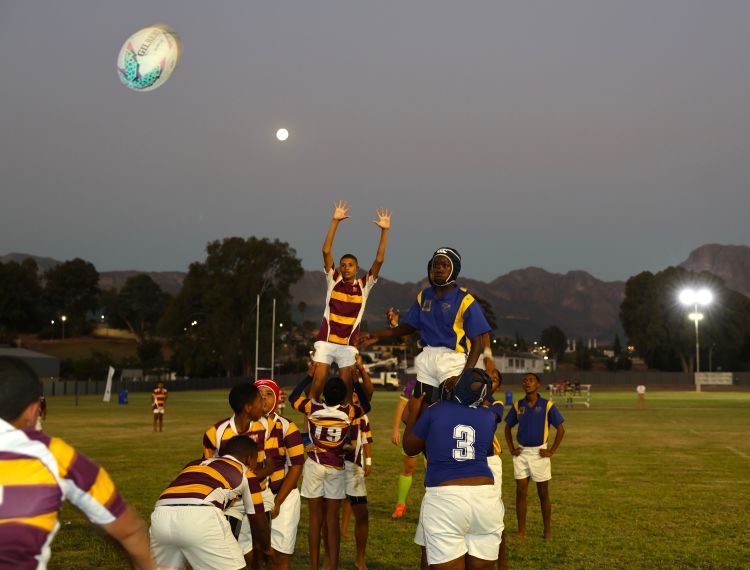
In honour of Die Kraal's official reopening, attendees were treated to the first match on the restored fields — a spirited clash between two local schools that set the tone for a very special day.
In honour of Die Kraal's official reopening, attendees were treated to the first match on the restored fields – a spirited clash between Ebenezer Primary and Paulus Joubert Primary that set the tone for a very special day.
“Die Kraal will not remain a memory; it will live again," said Councillor Stephen Korabie, Executive Mayor of Drakenstein Municipality. He emphasised that the project formed part of the Municipality's broader R55-million vision to invest in people, opportunity and youth development through sport.
The Executive Mayor highlighted that the reopening honoured the past while creating a space where future players can grow, connect and dream. “Today, Die Kraal rises again as a symbol of the fact that we remember, we rebuild, and we move forward together."
Die Kraal remains a municipal facility and, like all other municipal amenities, will continue to be available for public use – a shared space where the community can gather, play and grow together.
The reopening forms part of Phase 1 of a four‑phase redevelopment plan.
Completed upgrades include:
• Two rugby fields;
• High‑mast lighting;
• New sprinkler systems;
• Revitalisation of the “A" and “B" practice fields;
• Turnstiles;
• Temporary toilets and changing rooms;
• Surveying and preparation of two new rugby fields;
• Installation of rugby poles donated by the Val de Vie Foundation;
• Partial formalisation of parking areas; and
• Temporary mobile spectator seating.
Phase 1 lays the foundation for the Municipality's long‑term vision: a modern, inclusive, multi‑sport precinct that nurtures future stars while preserving the heritage of those who came before.
“What you see here, is not just development. It is restoration. It is respect for those who came before us, and responsibility toward those who will come after us," said the Executive Mayor.
Former rugby players and community leaders engaged actively in discussions about Die Kraal's future identity, contributing ideas for a multi‑sport hub, a heritage museum and enhanced community facilities.
Randy “Yster" Marinus, one of Paarl's most celebrated rugby figures, reminisced about matches played at Die Kraal as a member of Gardens Rugby Football Club (RFC).
Marinus would later rise to national prominence, earning selection for the Proteas (South African Rugby Football Federation or SARF) at just 19 years old to face the touring All Blacks in 1976. He captained the SARU team, earning recognition as one of the top rugby players of his time.
“It warms my heart to stand here today. Everyone sitting here has stories about Die Kraal, and later on, we will be talking for a long time."
The Municipality reaffirmed its commitment to ongoing collaboration with local clubs, former athletes, and resident organisations to ensure the renewed Die Kraal remains deeply rooted in community ownership and pride.

The Die Kraal Sports Grounds rise again! Drakenstein Municipality has officially reopened the historic sports grounds, marking the start of a proud new era for community rugby.
As laughter, memories and shared stories filled the grounds once more, the reopening of Die Kraal became far more than a ceremonial moment. It signalled the revival of a historic space that continues to shape the cultural and sporting identity of Paarl East.
From now on, 31 March will be celebrated as Die Kraal Day in Drakenstein — a lasting tribute to the spirit of community, heritage and sporting excellence that the grounds embody.
[ENDS]
Issued by: Communication and Marketing, Drakenstein Municipality
About Drakenstein Municipality
Located an hour's drive from Cape Town in the Western Cape province of South Africa, Drakenstein Municipality encompasses Paarl, Wellington, Mbekweni, Gouda, Hermon, Saron and Simondium. It boasts the largest economy in the Cape Winelands and is home to 311 601 residents. Drakenstein Municipality is one of the country's most financially sound, well-governed, stable and sustainable municipalities - recognised specifically for its good governance and service excellence. The Municipality has been rated South Africa's number one secondary city and has, since 2011, achieved 11 clean audits.
Visit our website at www.drakenstein.gov.za or follow us on Facebook, Instagram, LinkedIn and YouTube.